Comprehensive Guide to Domain Names and Brand Identity
Your domain name is more than a URL — it's your brand's first impression. This guide breaks down how to choose, protect, and launch a branded domain that works in search, in ads, and in conversation.
Understanding the Importance of Domain Names
What Makes a Domain Truly Branded
A branded domain is not just descriptive—it is distinctive, memorable, and ownable.
A domain becomes branded when it:
- creates a unique association (“novara.art”)
- is not easily replaceable with synonyms
- builds recognition over time
- works as a standalone identifier in speech and memory
Examples of branded domains in the art space:
- “artsper.com” — not descriptive, but recognizable as a platform
- “saatchiart.com” — tied to a strong brand identity
- “foundation.app” — abstract but highly memorable in the NFT space
- “superrare.com” — suggestive, but clearly brand-owned
.art examples:
- “artify.art”
- “lumina.art”
- “novara.art”
These names do not just describe—they differentiate.
Branded vs Generic Domains
Understanding the difference is critical for domain branding.
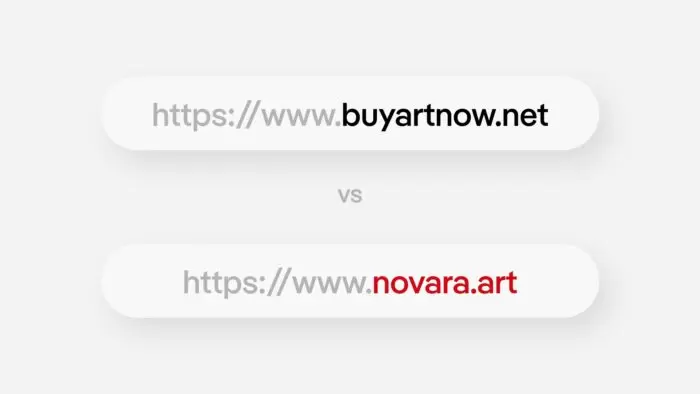
Generic domains:
- “onlineartgallery.com”
- “buyartnow.net”
Characteristics:
- keyword-heavy
- interchangeable
- low brand recall
Branded domains:
- “artsy.net”
- “novara.art”
Characteristics:
- unique
- memorable
- defensible
Why this matters:
- Generic domains compete on SEO
- Branded domain names build long-term equity
Criteria for an Effective Branded Domain
An effective branded domain typically meets these criteria:
- Distinctiveness — not easily confused with others
- Memorability — easy to recall after one exposure
- Pronounceability — easy to say out loud
- Scalability — not tied to one niche only
- Visual clarity — easy to read and type
Example comparison:
- “digitalabstractpaintings.art” — descriptive but weak brand
- “artora.art” — short, unique, scalable
Why Spoken Domains Matter
A critical but often overlooked factor: domains are frequently spoken aloud.
This happens in:
Podcasts
- Hosts say: “Visit us at lucidforms.art”
- Short, clear domains are easier to understand without visual support
Video content
- YouTube or interviews: spoken mentions drive traffic
- “Check out motionstudio.art” works better than long domains
Offline advertising
- Posters, exhibitions, gallery signage
- Visitors must remember the domain after seeing it briefly
Word of mouth
- “I found this artist at bluevoid.art”
- If the name is unclear, the traffic is lost
Key implication: If a domain is hard to pronounce or spell, it loses real-world traffic.
Domain Names and Performance Metrics
Domain names directly influence acquisition and conversion metrics.
CTR (Click-Through Rate)
A relevant domain increases CTR in search and ads.
Example:
- “modernsculpture.art” vs “bestgalleryonline.com”
The first aligns with intent and attracts more qualified clicks.
Landing Page Trust
Users evaluate trust before engaging.
Trust signals from domains:
- clean structure — “formstudio.art”
- relevant extension — .art for creatives
Result:
- lower bounce rates
- longer session duration
Ad Recall
Branded domains improve recall after exposure.
Example:
- “lumina.art” is easier to remember than “best-art-platform-online.com”
This directly impacts:
- return visits
- brand awareness
Direct Traffic
Strong branded domains generate direct visits.
Example:
- Users typing “artsy.net” directly instead of searching
Why it happens:
- memorability
- repeated exposure
Conversion Lift
Domains influence conversion indirectly through trust and clarity.
Example comparison:
- “premiumgallery.art” — clear positioning — higher perceived value
- “cheapartdeals.net” — lower trust — weaker conversions
Result:
- better conversion rates
- stronger brand perception
The Role of Domain Names in Brand Identity
A domain name is not just a technical address. It is a core part of brand identity, especially in visually driven industries like art. In many cases, the domain is the first thing a user sees before interacting with any content.
For example:
- “futuregallery.art” immediately communicates a contemporary, forward-looking art space
- “motionstudio.art” suggests a focus on animation or digital media
- “canvascollective.art” positions itself as a curated group of artists
These are examples of domain branding in action. The domain itself tells a story before the user even clicks.
Branded domain names are particularly powerful because they:
- reinforce identity
- improve memorability
- increase direct traffic
This is why a domain name is important—it becomes part of how people recognize and recall your brand.
Difference Between Domain Name and Brand Name
A brand name is your identity. A domain name is how people find that identity online.
Strong brands align both.
Good alignment example:
- Brand: “Lightform Studio”
- Domain: “lightform.art”
Weak alignment example:
- Brand: “Lightform Studio”
- Domain: “bestdigitalgalleryonline.com”
In the second case, users experience friction because the domain does not match expectations.
Key differences:
- Brand name — emotional and conceptual identity
- Domain name — functional and discoverable identity
Best practice: keep them as close as possible.
Impact of Domain Names on Customer Perception
Users judge credibility almost instantly.
Compare:
- “immersivegallery.art”
- “top-art-site-2024.net”
The first feels curated and professional. The second feels generic and unreliable.
Why this happens:
- Clean domains signal expertise
- Relevant keywords build trust
- Simplicity reduces cognitive load
In art, perception is everything. A poorly chosen domain can undermine even high-quality work.
Creating Memorable and Unique Domain Names
Strategies for Choosing a Domain Name
Effective domain selection follows a few proven principles.
1. Keep it short and clear
- “boldforms.art” is easier than “thebestboldformsgallery.art”
2. Use meaningful words
- “colorfield.art” instantly suggests a style
3. Avoid complexity
- No hyphens
- No numbers
Bad example:
- “art-4-you.art”
Better alternative:
- “artforyou.art”
4. Test memorability
Ask yourself:
- Can someone remember it after hearing it once?
- Can they spell it correctly?
Five Proven Domain Name Formulas
Here are five structures that consistently work:
- Name + Art — “olivergrant.art” — Strong for personal branding
- Concept + Art — “endlessforms.art” — Great for thematic projects
- Style + Studio — “minimalstudio.art” — Positions aesthetic clearly
- Location + Art — “londonabstract.art” — Useful for local visibility
- Abstract Brand Name — “novara.art” — Flexible and scalable
These formulas work beyond .art, but in .art they gain additional semantic clarity.
Industry-Specific Approaches for Domain Names
Different art sectors require different approaches.
Fine artists
- Prefer personal domains
- Example: “emilyclark.art”
Digital/NFT artists
- Prefer conceptual or tech-forward names
- Example: “pixelwave.art”
Galleries
- Prefer descriptive or location-based names
- Example: “newyorkmodern.art”
Art platforms
- Prefer abstract, scalable brands
- Example: “artify.art”
The domain should match audience expectations within the niche.
Aligning Domain Names with Brand Strategy
Brand Consistency and Domain Names
Consistency across platforms strengthens recognition.
Example ecosystem:
- Domain: “lucidforms.art”
- Instagram: “@lucidforms”
- Email: “hello@lucidforms.art”
This alignment:
- reduces confusion
- improves trust
- increases recall
Enhancing Memorability Through Domain Selection
Memorable domains often share common traits:
- Visual language: “silvercanvas.art”
- Emotional tone: “quietspace.art”
- Simplicity: “form.art”
Why it works:
- Humans remember imagery better than abstract text
- Emotional words create stronger recall
The Role of Domain Extensions in Brandability
Domain extensions are not neutral—they shape perception.
Compare:
- “futuregallery.art”
- “futuregallery.com”
The .art version:
- is more relevant
- communicates niche instantly
- attracts a targeted audience
This makes .art particularly strong for creative professionals, though the same principle applies to other niche TLDs.
Protecting Your Brand with Domain Names
Preventing Brand Dilution
Brand dilution happens when similar domains confuse users.
To prevent it, register:
- primary domain — “visualstudio.art”
- variations — “visualstudio.com”
- common misspellings — “visualstudios.art”
This protects traffic and brand integrity.
Protecting Against Domain Squatting
Domain squatters register names to resell or exploit traffic.
Example risk:
- You build “aurorastudio.art”
- Someone registers “aurorastudios.art”
Prevention strategies:
- Register early
- Secure key variations
- Monitor similar domains
Legal Considerations and Brand Integrity
Before registering a domain:
- check trademarks
- verify name uniqueness
- avoid conflicts
In art, names often overlap conceptually. Proper checks prevent costly disputes.
Building a Strong Online Presence
Domain Name Consistency for Brand Recognition
A consistent structure improves recognition.
Example network:
- “parisgallery.art”
- “tokyogallery.art”
- “berlingallery.art”
Users quickly understand the pattern and trust the system.
Future-Proofing Your Domain Strategy
Avoid overly narrow domains.
Risky:
- “watercolorpaintings.art”
Flexible:
- “studiomotion.art”
Flexible domains allow:
- expansion into new mediums
- brand evolution
- long-term growth
Action Plan for Domain Acquisition
30-Day Domain Acquisition and Launch Plan
This plan uses tools from the .ART ecosystem.
Week 1: Research and discovery
- Use search.art.art to explore available domain names
- Test variations and keyword combinations
- Shortlist 5–10 strong branded domain names
Week 2: Secure domains
- Register your primary domain
- Register key variations and backups
- Prioritize clarity and brand alignment
Week 3: Build your site
- Use the .ART website builder
- Create portfolio pages, about section, and contact page
- Set up a professional email (e.g., hello@yourname.art)
Week 4: Launch and optimize
- Publish the site
- Connect analytics
- Share across social platforms
- Ensure consistent branding everywhere
This structured approach minimizes delays and ensures strong domain branding from day one.
Frequently Asked Questions
Why Invest in a Personal Domain Name?
A personal domain:
- reinforces ownership
- builds credibility
- acts as a digital signature
Example: “danielreed.art” is easier to trust and remember than a social profile URL.
What Makes a Good Domain Name?
A strong domain is:
- Short — “boldart.art”
- Relevant — “motiondesign.art”
- Memorable — “bluevoid.art”
Avoid long phrases, numbers, and unnecessary symbols.
Creative Alternatives for Domain Names
If your ideal name is taken, try:
- adding a concept — “formlab.art”
- using abstraction — “novara.art”
- combining words — “artshift.art”
Niche extensions like .art make many premium names available.
Cost Considerations for Domain Names
Costs vary depending on availability, demand, and premium status.
General breakdown:
- standard domains — low annual cost
- premium domains — higher upfront investment
Premium domains often provide better branding long-term.
Steps to Launch a Website After Securing a Domain
- Connect domain to hosting or builder
- Design website structure
- Upload portfolio and content
- Optimize for SEO
- Launch and promote
Each step strengthens your online presence and brand visibility.